6 months ago
 SHARE
SHARE
SHARE
PAYROLL & COMPLIANCE
How Smart Planning Prevents Cost Overruns in Interior Projects
Interior projects — whether office fit-outs, workspace redesigns, or facility upgrades — are notorious for budget drift. What starts as a planned spend can quickly inflate well beyond the original estimate. However, the root cause of most cost overruns isn’t random market change — it’s poor upfront planning and execution.
Let’s explore how smart planning dramatically reduces cost risk and creates successful, timely, and profitable interior projects.
Understanding Cost Overruns: What Really Drives Them
A cost overrun occurs when the actual project expenses exceed the planned budget. Although external factors like material price volatility or labor shortages can contribute, most overruns stem from predictable, preventable causes:
• Inaccurate budgeting
• Scope changes mid-project
• Poor risk management
• Communication failures between teams
• Reactive rather than proactive planning
Industry research highlights that planning and scheduling deficiencies contribute more to cost issues than any other factor — surpassing even contractor performance alone.
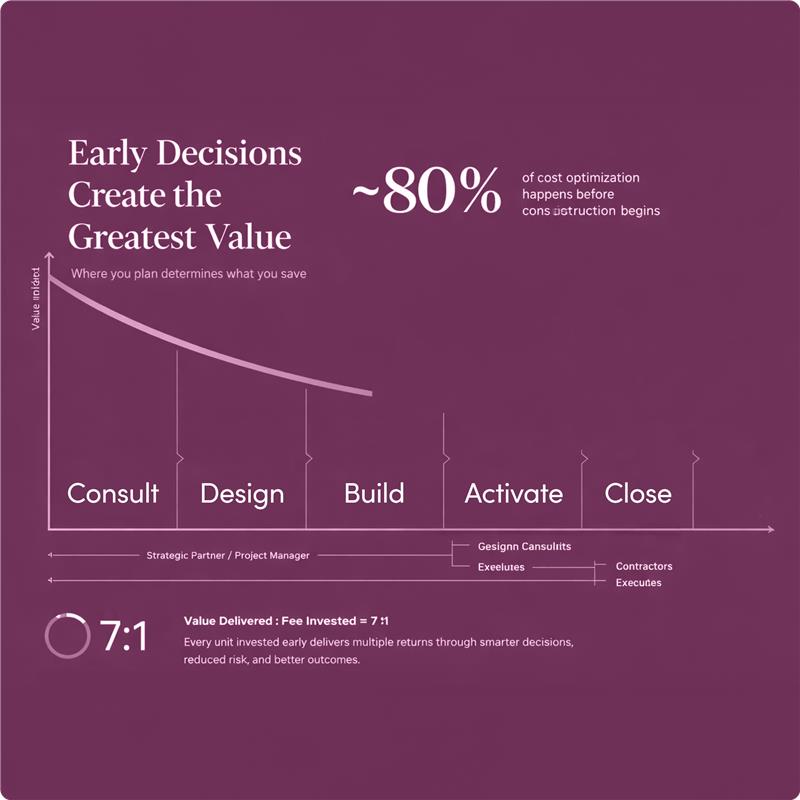
Smart Planning: The Foundation Against Cost Overruns
1. Detailed Budget & Scope Definition
The core reason planning matters is simple: every cost estimate reflects assumptions. When those assumptions aren’t grounded in realistic scenarios or detailed scopes, budgets become fragile.
Planners should:
• Itemise all expenditure categories
• Define deliverables clearly
• Include realistic rates for materials, labor, and equipment
• Account for administrative, permitting, and change costs
This structured approach eliminates surprises and fosters clarity before execution begins.
2. Risk Assessment & Contingency Planning
Effective planning anticipates risks rather than discovers them. This means:
• Identifying potential scope changes early
• Assessing impacts of design revisions
• Allocating contingency reserves (typically 10–15% of the total budget) for unforeseen challenges
Without a risk-based planning mindset, even minor issues can inflate costs unexpectedly.
3. Real-Time Monitoring & Control Mechanisms
Modern project planning isn’t static. Smart planning embeds monitoring frameworks that track actual costs against forecasted spending. This tightens control and enables early corrective action — the key to preventing minor overruns from becoming major budget breaches.
Technology tools (e.g., AI-enabled cost tracking) can alert project teams in real time when spending trends deviate from the plan.
4. Clear Communication & Stakeholder Alignment
Cost overruns rarely happen in isolation. They often occur when teams, designers, contractors, and clients operate with different assumptions.
Smart planning includes:
• Regular budget and progress reviews
• Transparent documentation of changes
• Clear escalation paths for scope requests
• Alignment of expectations at every stage
This helps reduce scope creep — a common driver of budget expansion.
5. Phased Planning & Design Considerations (Design-Build Approach)
The “design-build” model — where design and construction planning happen in an integrated phase — is shown to reduce risks related to design errors and cost surprises. By involving contractors earlier in the design phase, projects can avoid last-minute changes and clarifications that lead to budget inflation.
Case in Point: Office Expansion Without Planning
Real-world data shows that organisations that push expansion without planning spend up to 40% more and face operational disruptions compared to those that integrate future needs into early planning phases.
This isn’t just about money — it’s about:
• Efficiency
• Timeline adherence
• Quality of outcome
• Employee productivity post-fit-out
Interior projects are complex by nature. But most cost overruns are not inevitable — they are avoidable with disciplined planning and control.
By investing time in detailed budgeting, risk assessment, real-time cost tracking, aligned communication, and integrated design processes, organisations can protect their budgets, timelines, and quality expectations.
Smart planning stops cost overruns before they start — transforming interior projects from reactive budget battles into predictable, value-driven outcomes.